
Module 2. TMS Safety Checklist
How and why a trained staff member should complete the TMS Safety Checklist using information from the patient, their family, and clinical notes.
Overview
Before TMS testing, a trained staff member must screen the patient for absolute contraindications and safety considerations. The patient’s physician must approve the completed checklist before testing.
The TMS Safety Checklist identifies contraindications and safety considerations. If you use a different checklist ensure that it aligns with the latest guidelines from the International Federation of Clinical Neurophysiology. Information from the patient, their family, and clinical notes supports the physician’s decision on whether TMS can proceed.
The TMS Checklist provides an opportunity to discuss possible PREP2 predictions. For patients with a day 3 NIHSS score below 7, the two possible post-TMS predictions are Good or Limited. For patients with a day 3 NIHSS score of 7 or more, the two possible post-TMS predictions are Good or Poor. Discussing these possibilities during the safety screening helps prepare the patient and their family for the result.
Ask whether the patient wants to receive the prediction immediately after testing or later. If they prefer to wait, record the prediction in the clinical notes until they and their family are ready to discuss it.
The provided checklist records the patient’s preference, identifies the staff member who completed it, and documents the physician’s decision.
Present condition
Outline the patient’s current medical condition, for example the location and day of the stroke and what current impairments the patient is experiencing. Any other current medical issues should also be noted. This information helps the physician evaluate suitability for TMS.
Past medical history
Outline the past medical history as described in the notes and by the patient. This allows the physician to review any additional information that may need to be considered when evaluating suitability for TMS.
Current medications
For PREP2, the patient’s physician who reviews the checklist should have the expertise to review the list of patient’s medications, including dose information, to evaluate whether TMS is appropriate.
Patient preference
The TMS Safety Checklist prompts you to ask if the patient and their family wish to know the results of the TMS testing. It’s important to discuss this with the patient and their family at the time of TMS safety screening. Occasionally, patients don’t feel ready to hear their prediction straight away. If they would rather wait, then their prediction can be recorded in their clinical notes, ready for when the patient and their family ask for it.
TMS Safety Checklist Questions
ABSOLUTE CONTRAINDICATIONS
TMS is contraindicated if the answer to any of the below questions is YES.
TMS can interfere with the function of implanted electronic devices. The first 3 questions relate to stimulators that could be affected by TMS. Stroke patients with any of the following devices cannot receive TMS.
1. Does the patient have a cochlear implant?
2. Does the patient have a cortical stimulator?
3. Does the patient have a deep brain stimulator?
One question relates to ventriculoperitoneal shunts as these might be affected by TMS.
4. Does the patient have a ventriculoperitoneal shunt?
Two questions ask about more serious brain injury relating to the patient’s current stroke that could increase the risk of a TMS-induced seizure.
5. Does the patient have a skull defect related to their current admission?
6. Has the patient experienced seizures related to their current admission?
There can be uncertainty about whether a seizure has occurred, consult physician if in doubt
The final two questions relate to further potential risks. TMS is contraindicated for people who have previously had a serious adverse reaction to TMS, such as a seizure, as it may happen again in response to TMS. TMS is also contraindicated for people who take anti-epilepsy medication but experience break-through seizures.
7. Has the patient experienced a prior TMS-related serious adverse event
8. Has the patient had a seizure in the last 12 months while taking anti-epilepsy medication?
TMS SAFETY CONSIDERATIONS
These are not necessarily contraindications to TMS but questions with a YES answer should be discussed with the team physician.
Does the patient have a history of epilepsy?
Does the patient have intracranial implants, such as clips or stents, or skull plates?
Does the patient have any implanted electronics?
Has the patient ever had a skull fracture or brain surgery?
Is the patient pregnant?
Does the patient experience recurring headaches?
Does the patient experience tinnitus or hyperacusis?
Therapist's section
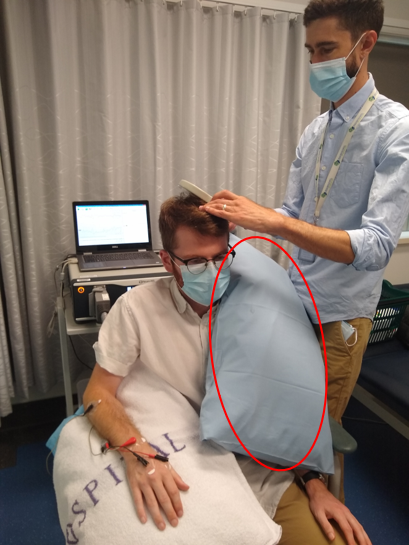
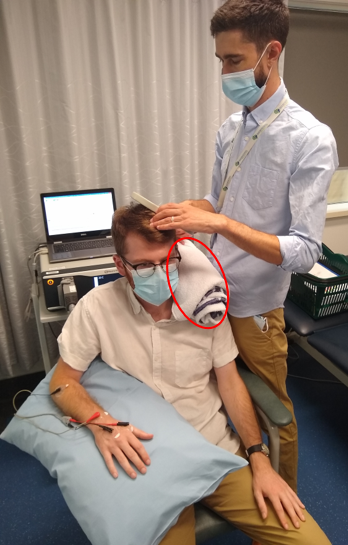
The therapist section at the end of the checklist allows documentation of whether additional measures are needed during the assessment. One potential measure is the use of spacers for people with implanted electronics. Spacers act as a visual cue to ensure the TMS coil is discharged only on the participant’s scalp and not closer to the location of the implanted device. They also prevent the coil from being physically close enough to the implanted device to be able to affect its functioning. Examples of spacers include pillows or a rolled up towel, and can be seen below. Ear plugs should also be offered to people with tinnitus or hyperacusis as hearing protection.
Physician’s section
The physician section allows clear documentation of whether TMS testing is approved for the patient or not.
Case Examples
Below is information for four example patients. Detail is given for any question that the patient answered ‘YES’ to, and the reasoning behind the physician’s decision to include or exclude each person is provided.
Mr Greenwald (35 y)
Present condition - Left hemisphere PCA stroke 3 days ago. Patient had clot retrieval 2 days ago, report showing a Solitaire 6 x 20 stent deployed.
Past medical history - None.
Current medications - Zopliclone 7.5mg PRN, Aspirin 100 mg daily, Clopidogrel 75 mg daily
Considerations Q4: Does the patient have intracranial implants, such as clips or stents, or skull plates? YES
If the implant is MRI compatible then it is safe for TMS.
Details to write on checklist for Q4: Patient had clot retrieval 2 days ago, report showing a Solitaire 6 x 20 stent deployed. Clot successfully retrieved. Stent is made of non-ferrous materials.
Decision: INCLUDE
The physician approved this patient for TMS. The clot retrieval and stent insertion was identified as a consideration, but as this stent is made of non-ferrous material the physician determined the patient was able to be included.
Mrs Ngata (60 y)
Present condition - Right hemisphere MCA stroke 4 days ago.
Past medical history - AF, gout, cochlear implant inserted at age 45 on left side.
Current medications - Diltiazem 120mg morning and evening, Aspirin 100 mg daily, Zopliclone 7.5mg PRN
Contraindications Q1: Does the patient have a cochlear implant? YES
Decision: EXCLUDE
The physician did not approve this patient for TMS because cochlear implants are an absolute contraindication.
Mx Lin (72 y)
Present condition - Left hemisphere basal ganglia stroke 4 days ago
Past medical history - Hypertension, dyslipidaemia, Type II diabetes, cardiac pacemaker implanted 5 years ago.
Current medications - Metformin 500mg morning and evening, Clopidogrel 75m daily, Atorvastatin 40mg daily, Metoprolol CR 47.5mg daily
Considerations Q3: Does the patient have any implanted electronics? YES
If yes use spacers during TMS testing.
Practice notes:
TMS with figure-8-coils is considered safe for individuals with cardiac pacemakers, vagus nerve stimulation systems, and spinal cord stimulators if the TMS coil is not activated close to (< 10 cm) electronic components such as the implanted pulse generator located in the neck or torso. TMS can also be conducted safely for patients with implanted electrodes in the central and peripheral nervous system that are not connected to a stimulator.
Details to write on checklist for Q3: Cardiac pacemaker implanted 5 years ago. No issues with it to date.
Decision: INCLUDE
The physician approved this patient because TMS is considered safe in individuals with cardiac pacemakers so long as the TMS coil is not discharged within 10 cm of the implanted device. Spacers should be used such as rolled up towels laid over the patient’s shoulders or a pillow placed over the patient’s chest as a reminder to the TMS operators to only discharge the coil on top of the participant’s head during TMS testing.
Mr Siakam (55 y)
Present condition - Left hemisphere MCA stroke 3 days ago
Past medical history - Hypertension, chronic left knee pain, head injury (see Q4)
Current medications - Paracetamol 500 - 1000mg up to every 6 hours as required, Clopidogrel 75mg daily, Metoprolol CR 23.75mg daily
Considerations Q4: Has the patient ever had a skull fracture or brain surgery? YES
Burr holes and other openings in the skull do not affect the field generated by TMS.
Practice notes:
Past skull fracture or brain surgery are not absolute contraindications, but ought to be considered by the physician and TMS operator.
Details to write on checklist for Q4: Assaulted 5 years ago. Lost consciousness for about 5 minutes. Admitted to hospital for a week. Discharge summary showed right parietal skull fracture, with extradural haematoma. Does not suffer any ongoing issues related to this incident.
Decision: INCLUDE
The physician approved this patient for TMS because they were no longer experiencing ongoing problems related to their skull fracture.
FAQs
How is the information for the TMS Safety Checklist collected?
1
A TMS Safety Checklist is completed by a trained staff member in consultation with the patient, their family, and a review of the patient’s clinical notes. Obtaining information from all these sources reduces the risk of missing essential information.
The completed TMS Safety Checklist should be signed off by the patient’s physician before TMS testing is commenced.
Who needs to approve the TMS Safety Checklist?
2
Notes should be added to the TMS Checklist to outline any changes and the physician that signed off the original checklist should be consulted to determine whether TMS testing is still appropriate.
What happens if the patient’s condition or medications change between sign-off and TMS testing?
3
What details are relevant when recording a patient's medications?
4
For all current medications the drug name and dosage should be recorded. Dosage information should consist of the dose, form, and frequency of the medication.
Quiz
Complete the practice quiz.
Score at least 70% to receive the final quiz link by email.
Score at least 80% on the final quiz to receive a certificate of completion. Attempts are unlimited.