
Module 6. Challenging MEP Identification
How to identify MEPs in EMG traces and determine MEP status in challenging cases.
Examples of challenging MEP identification
The examples below classify patients as MEP+ or MEP− when EMG traces are complicated by delayed latency or biological and non-biological artefacts (see module 3 EMG Technique). The traces shown should be treated as representative of all traces for each patient.
Patient A (height 5’5”, 165 cm) performing bilateral facilitation, 100% MSO.
The ECR trace shows a MEP-like deflection at ~70 ms. This latency is not biologically plausible for an MEP and so the deflection is likely a sporadic motor unit firing. No MEP is present in the FDI trace. Classify the patient as MEP−.
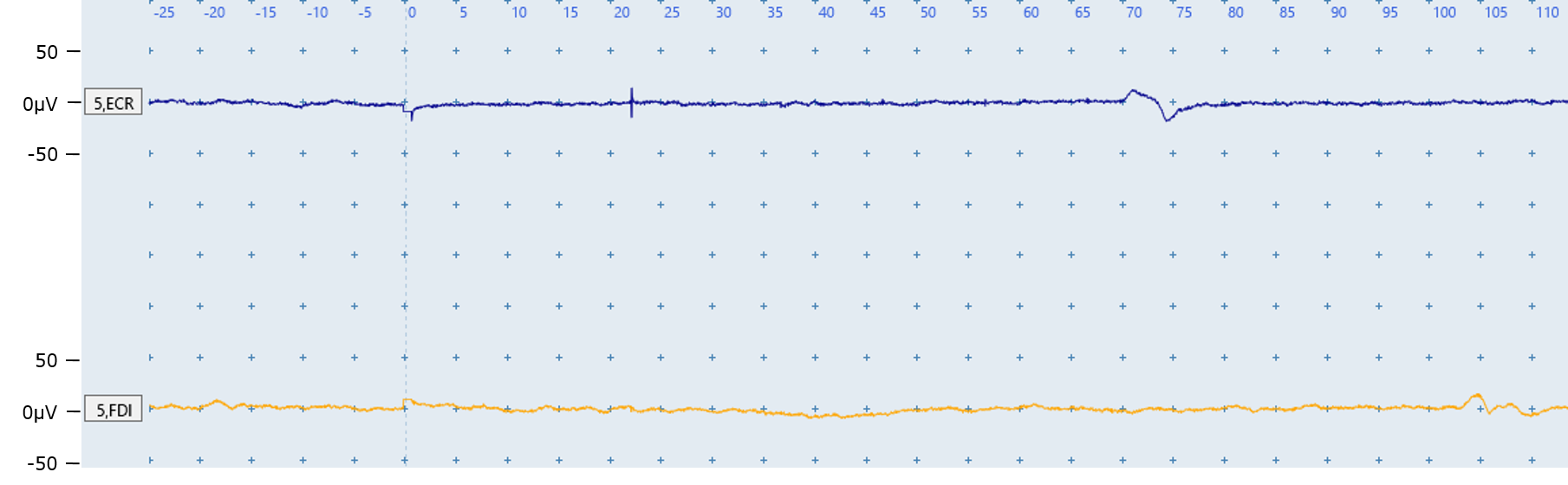
Patient B (height 5’8”, 173 cm) performing bilateral facilitation, 100% MSO
No MEPs were elicited at rest at 100% MSO, so the patient is performing bilateral facilitation. Low-level muscle activity is present in the ECR trace, but neither the ECR nor FDI trace contains a MEP. Classify the patient as MEP− despite all efforts to elicit one.
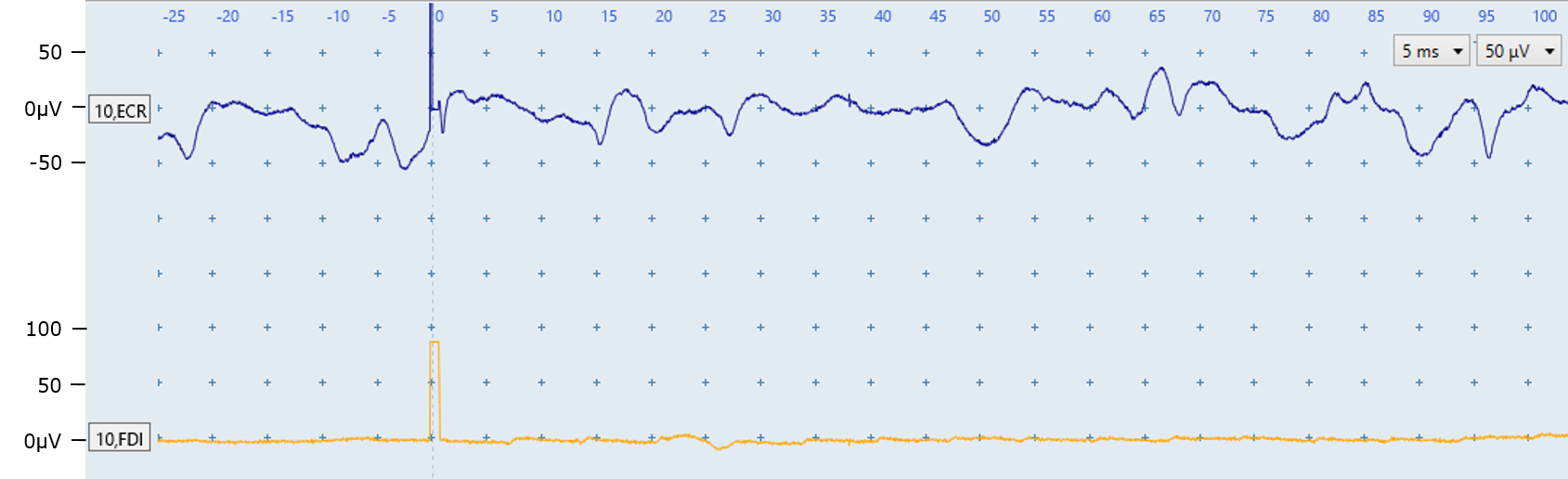
Patient C (height 5’7”, 171 cm) performing bilateral facilitation, 100% MSO
No MEPs were elicited at rest at 100% MSO, so the patient is attempting bilateral facilitation. Voluntary muscle activity is present in both traces. The FDI trace contains a clear MEP at an appropriate latency (~20 ms), whereas the ECR trace does not. Classify the patient as MEP+ based on the FDI MEP.
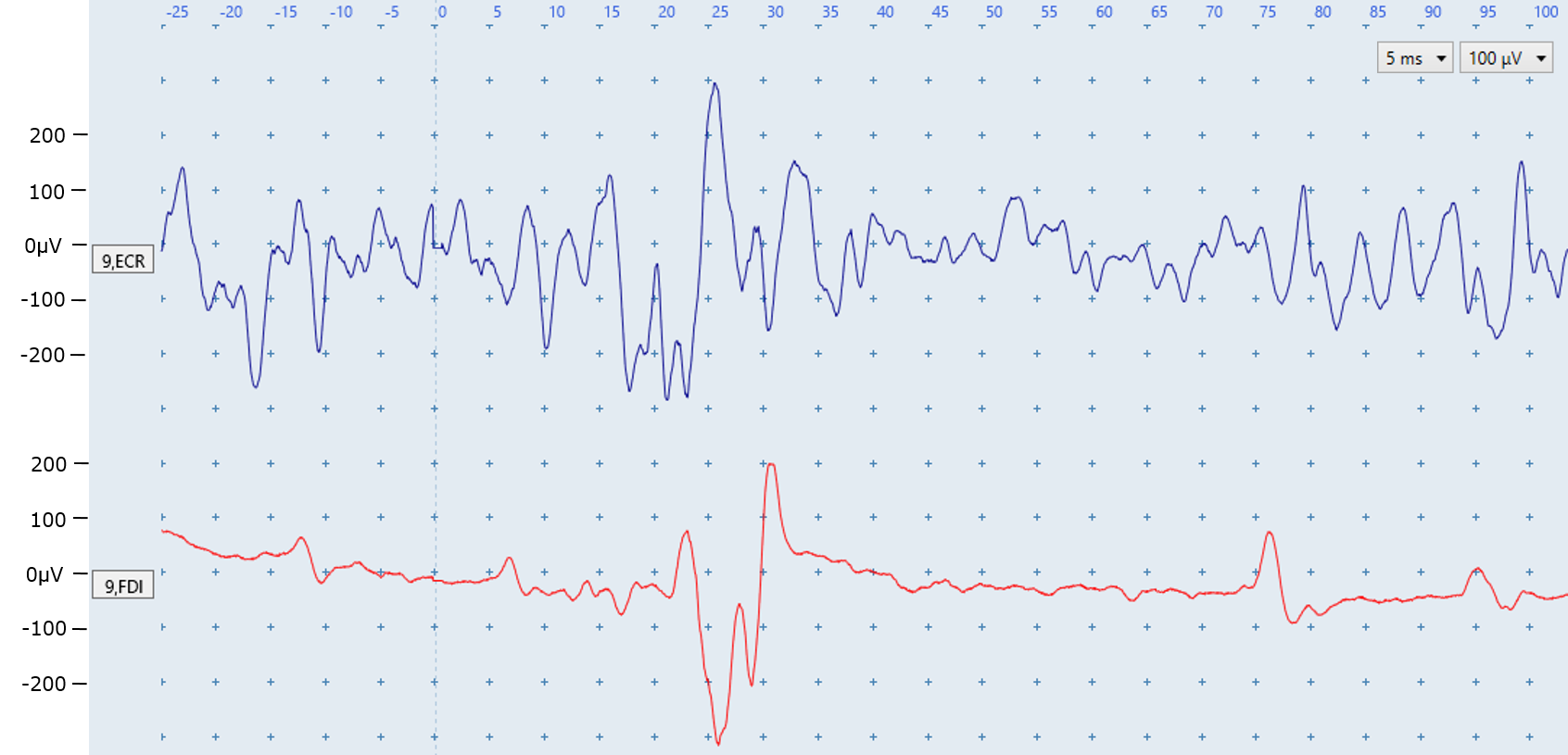
Patient D (height 5’6”, 168 cm) performing bilateral facilitation, 100% MSO
No MEPs were elicited at rest at 100% MSO, so the patient is attempting bilateral facilitation. Voluntary ECR muscle activity is present. The ECR trace contains an MEP at an appropriate latency (~20 ms), followed by a return to pre-stimulus muscle activity. The FDI trace also contains a MEP, although its latency is slightly later than expected. Classify the patient as MEP+ based on the ECR MEP.
If ECR MEPs were absent but FDI MEPs occurred at a similar latency (~34 ms) you would check MEP size and shape across other traces to exclude motor unit firing.
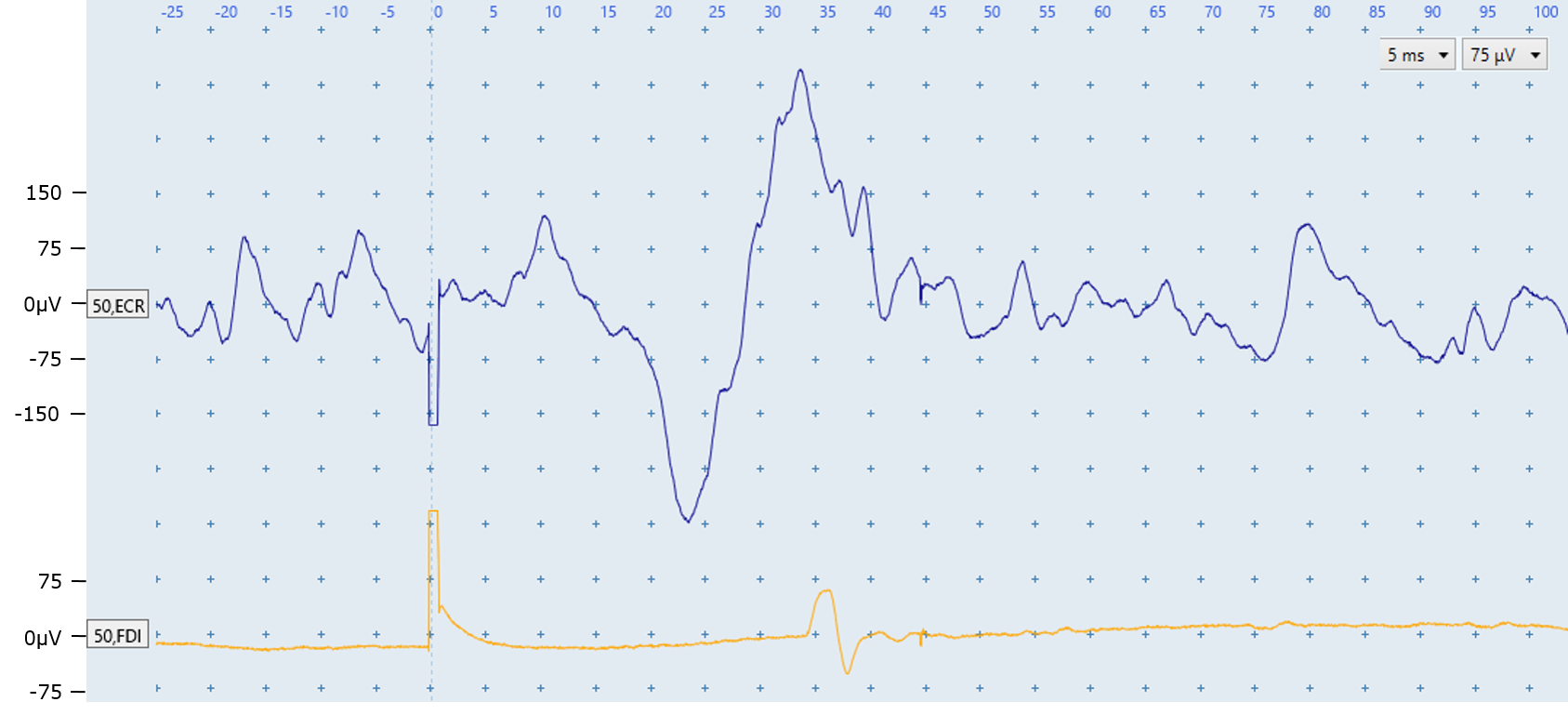
Patient E (height 5'6”, 168cm) at rest, 80% MSO
Electrical noise clearly contaminates the FDI trace. However, the ECR trace contains a MEP at an appropriate latency, so classify the patient as MEP+. Check the FDI set-up for a loose cable, poor electrode–skin contact, or a faulty electrode because the electrical noise is only present in one channel.
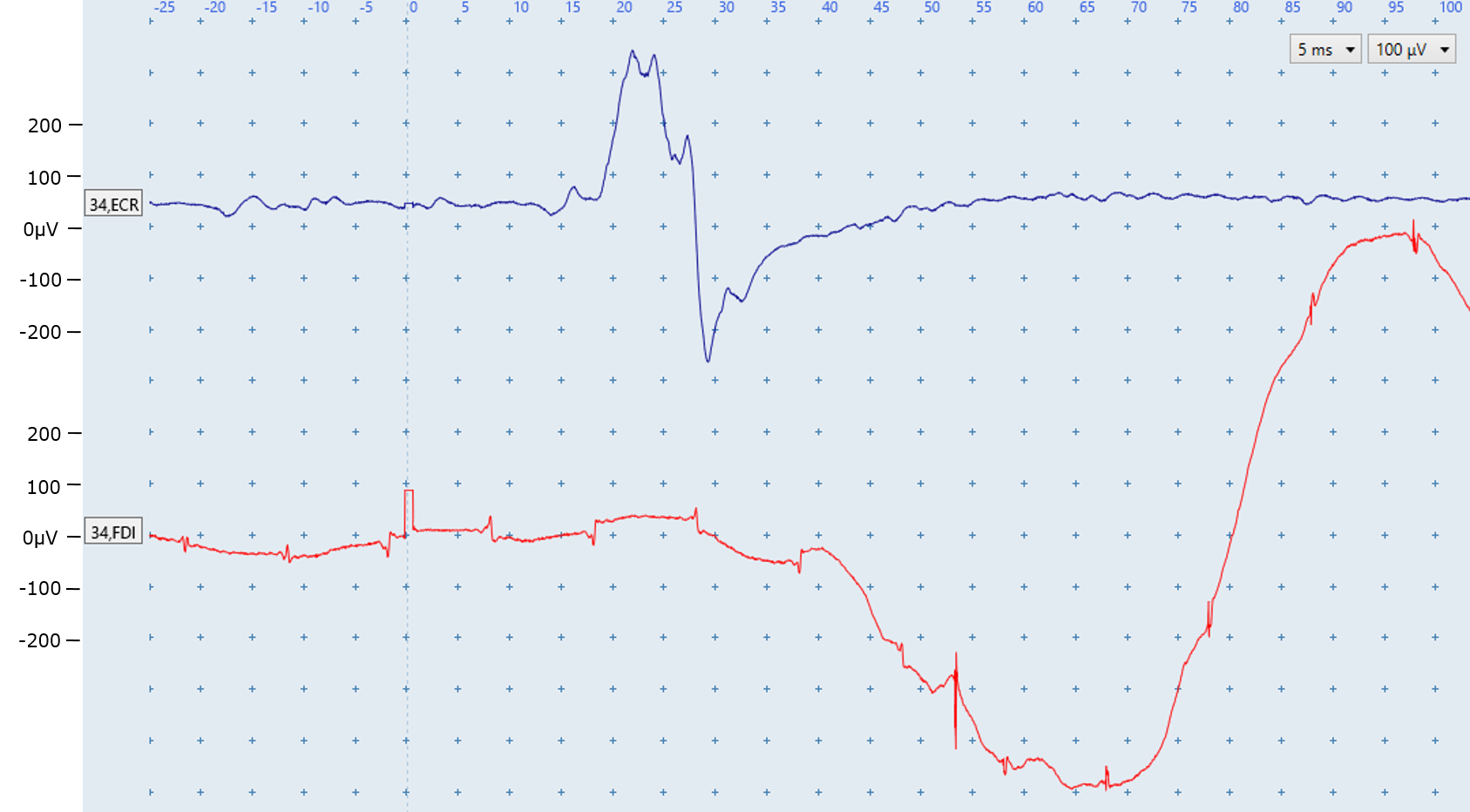
Patient F (height 5'9”, 176cm) at rest, 60% MSO
The FDI trace contains a clear MEP at an appropriate latency and the ECR trace contains a smaller MEP at an appropriate latency. Other fluctuations in both traces are sporadic motor-unit firing, identified by their consistent shape and size, implausible latencies for MEPs, and occurrence before the TMS stimulus. Classify the patient as MEP+ based on either MEP.
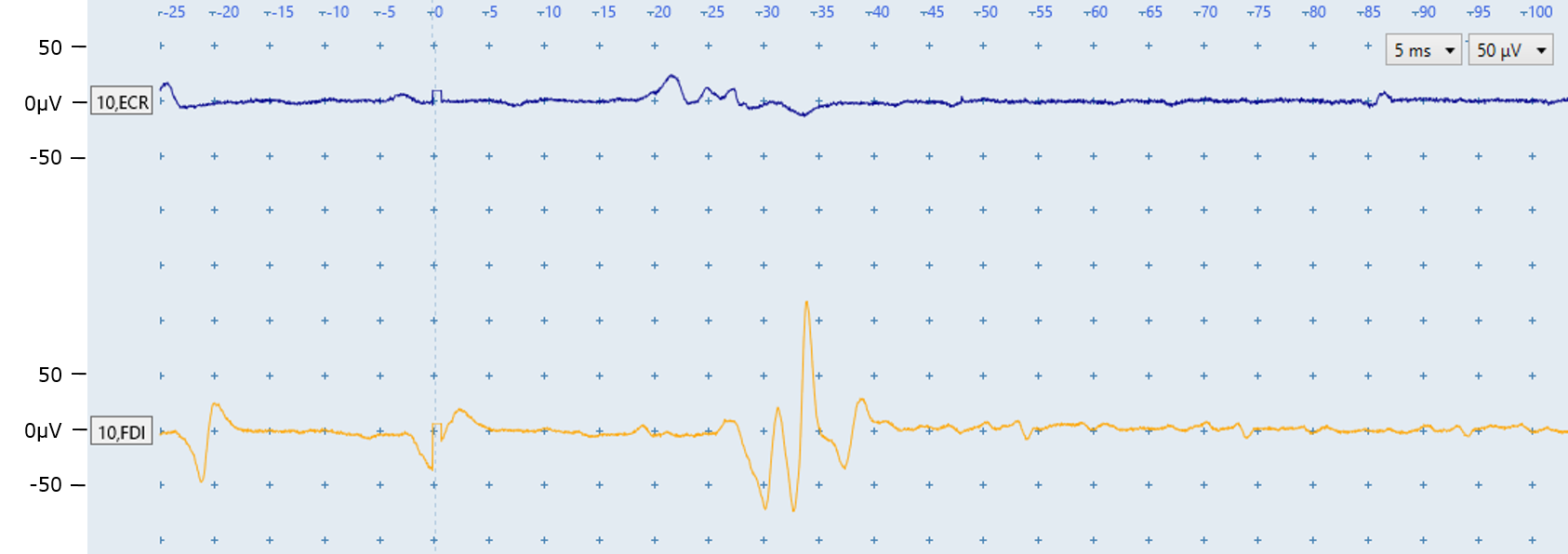
Patient G (height 5'7”, 170cm) at rest, 50% MSO
The elongated stimulus artefact and downward drift make the ECR trace hard to interpret. Check the ECR set-up for a loose cable, poor electrode–skin contact, or a faulty electrode. The FDI trace contains a response at an appropriate MEP latency, plus a similar small response at ~75 ms that may reflect motor-unit firing. Before classifying from the FDI trace alone, confirm that other FDI traces show a response at ~20 ms.
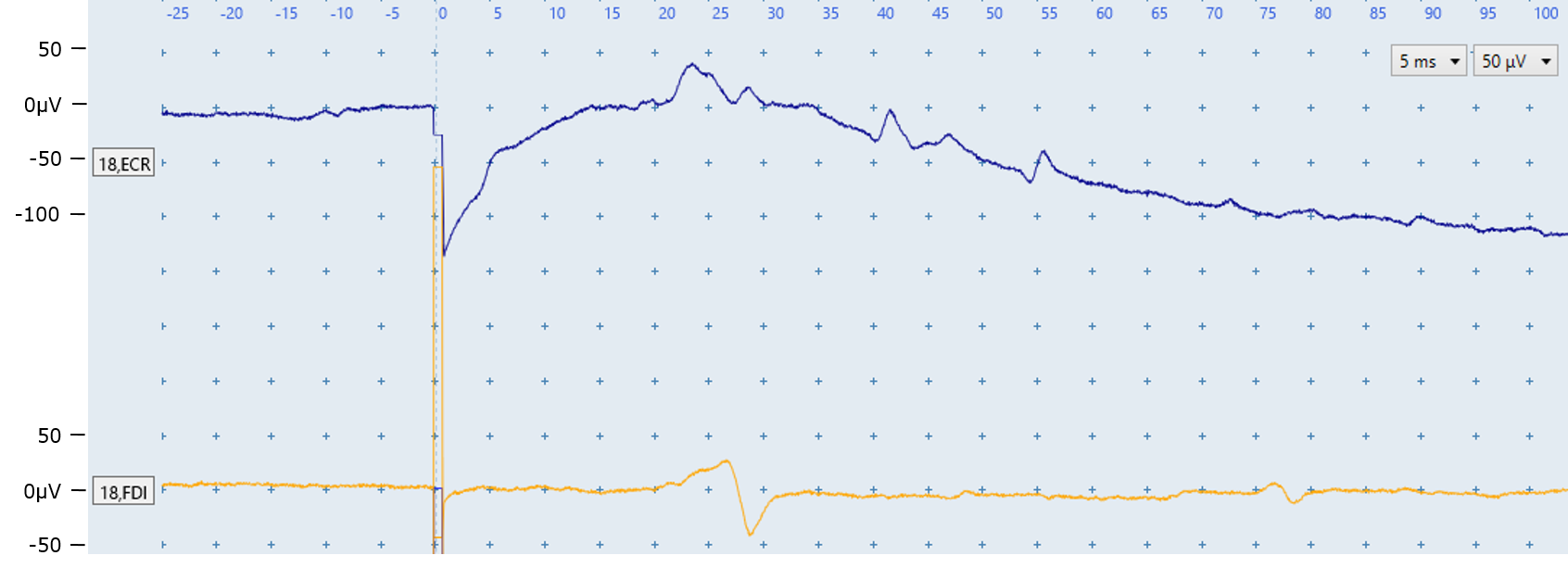
Patient H (height 5'8”, 170cm) at rest, 50% MSO
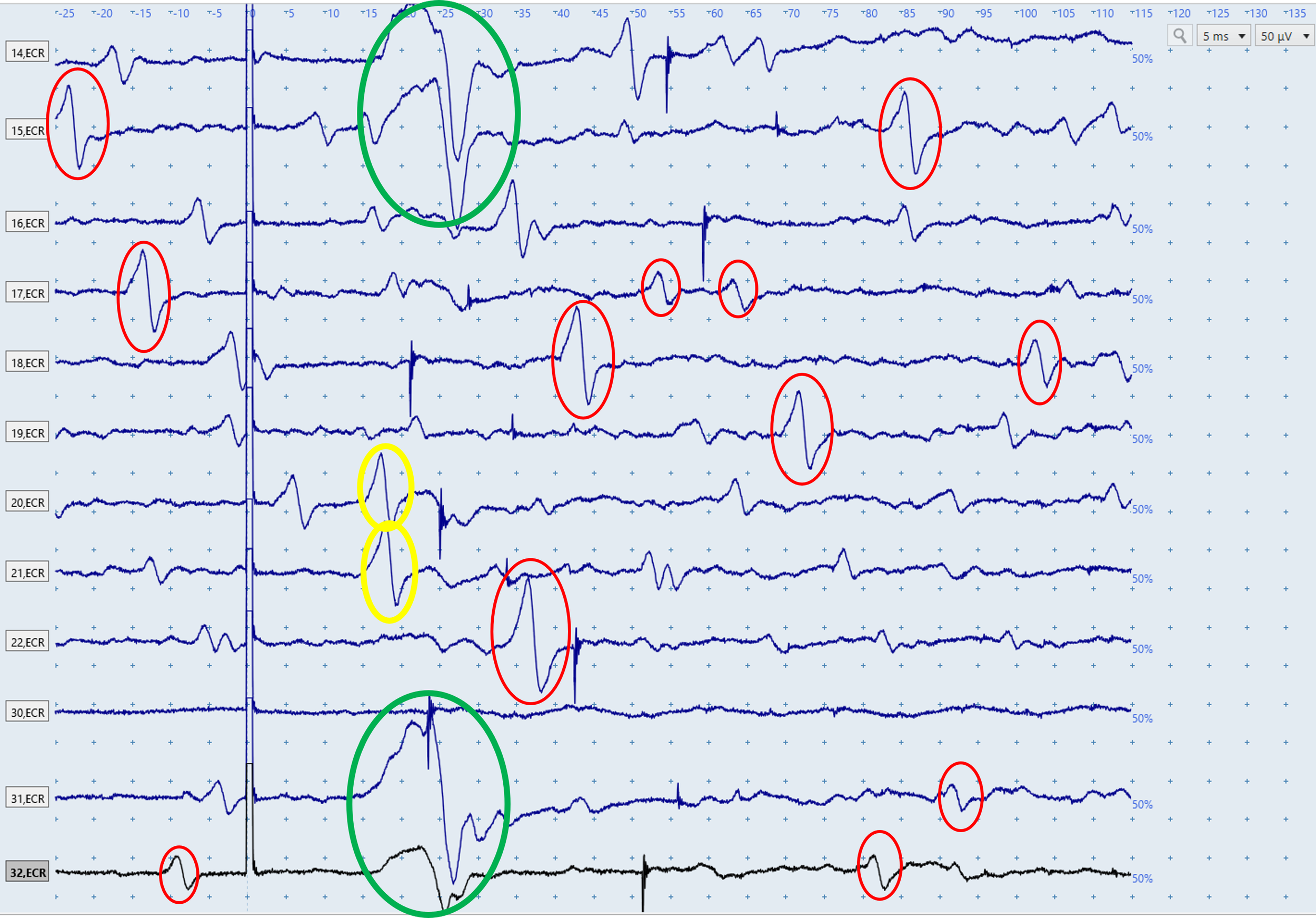
Each ECR trace follows a single stimulation. MEPs are present in the first two and last two traces (green circles): they have similar shapes and latencies of ~18 ms, within the expected ECR window. Numerous sporadic motor-unit discharges are also present (some marked in red); despite varying in size, they have consistent shapes and occur outside the expected MEP window. The yellow responses fall within that window but resemble the motor-unit discharges rather than the confirmed MEPs, so they are also likely motor-unit firing.
Patient I (height 6'1”, 185cm) at rest, 80% MSO
This image shows a series of FDI traces, and four traces contain nearly identical deflections at ~25 ms. Although their consistency could suggest motor-unit firing, they are more likely MEPs because they occur within the expected FDI latency window and do not appear at varying latencies across traces. The smaller deflections at ~42, ~60, and ~75 ms are more likely motor-unit activity. To confirm the ~25-ms responses, reposition the participant’s hand and arm, then increase stimulus intensity by 10% and assess whether response shape or amplitude changes.

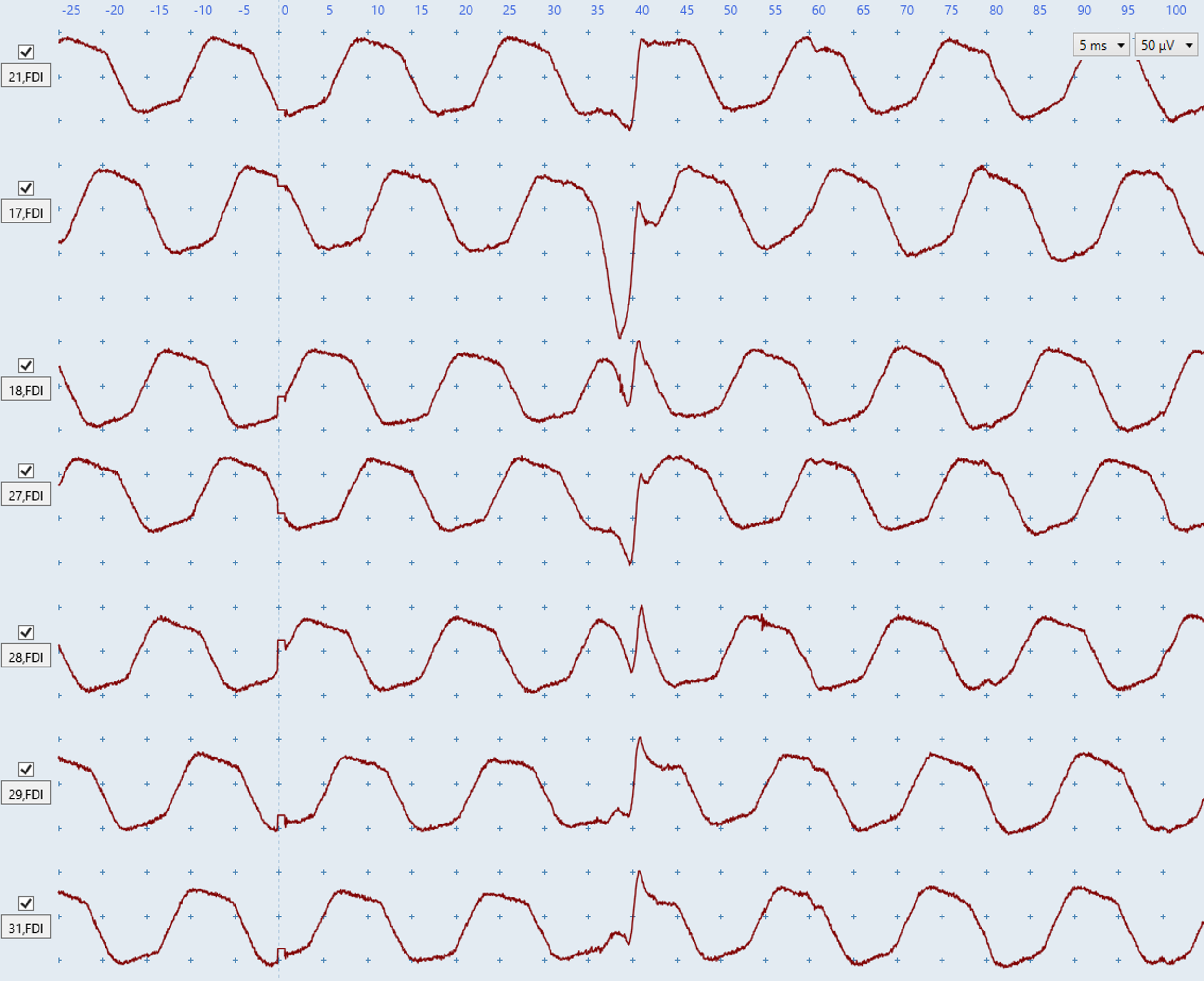
Patient J (height 6'6”, 198cm) at rest, 50% MSO
Severe electrical noise obscures the FDI traces, and individual traces—particularly 21 and 29—may appear to contain no MEP. Across all traces however, consistent deflections at ~38 ms indicate that the patient is MEP+. Even the upward deflection in trace 21 is sharper than the surrounding noise. Although ~38 ms is later than the typical FDI range (~20–30 ms), latency may be delayed after stroke and is influenced by height, so it remains plausible. Increase the stimulus intensity by 10% to determine whether the MEPs become larger and more distinct from the electrical noise.
I’ve finished the TMS test and I’m having trouble interpreting MEP status. I’m concerned about giving the patient an incorrect prediction. What should I do?
FAQs
1
Take your time. Do not deliver a prediction until you are confident of the MEP classification. Tell the patient and family that you will return once the traces have been reviewed. Discuss uncertain traces with TMS-trained colleagues, consult the examples and quizzes on this page, or seek support from your TMS trainers.
What should I do if there is a MEP in only one muscle, but the latency is a little later than I expect?
2
Check whether the response recurs at a similar latency across traces. Variable latency suggests sporadic motor-unit firing which would be further supported if response size andshape are highly consistent.
Quiz
Complete the practice quiz
Score at least 70% to receive the final quiz link by email.
Score at least 80% on the final quiz to receive a certificate of completion. Attempts are unlimited.