
Module 5. Simple MEP Identification
How to identify MEPs in EMG traces and determine MEP status in straightforward cases.
For more challenging cases, see module 6 Challenging MEP Identification.
Overview
Perform TMS testing on days 3–7 post-stroke after screening and approval. Testing outside this window may reduce prediction accuracy. If testing occurs on days 8–10, provide a prediction only when the patient is MEP−. Do not test after day 10.
Classify a patient as MEP- only when no MEP can be elicited at rest or during bilateral facilitation despite stimulation at 100% MSO and systematic coil positioning.
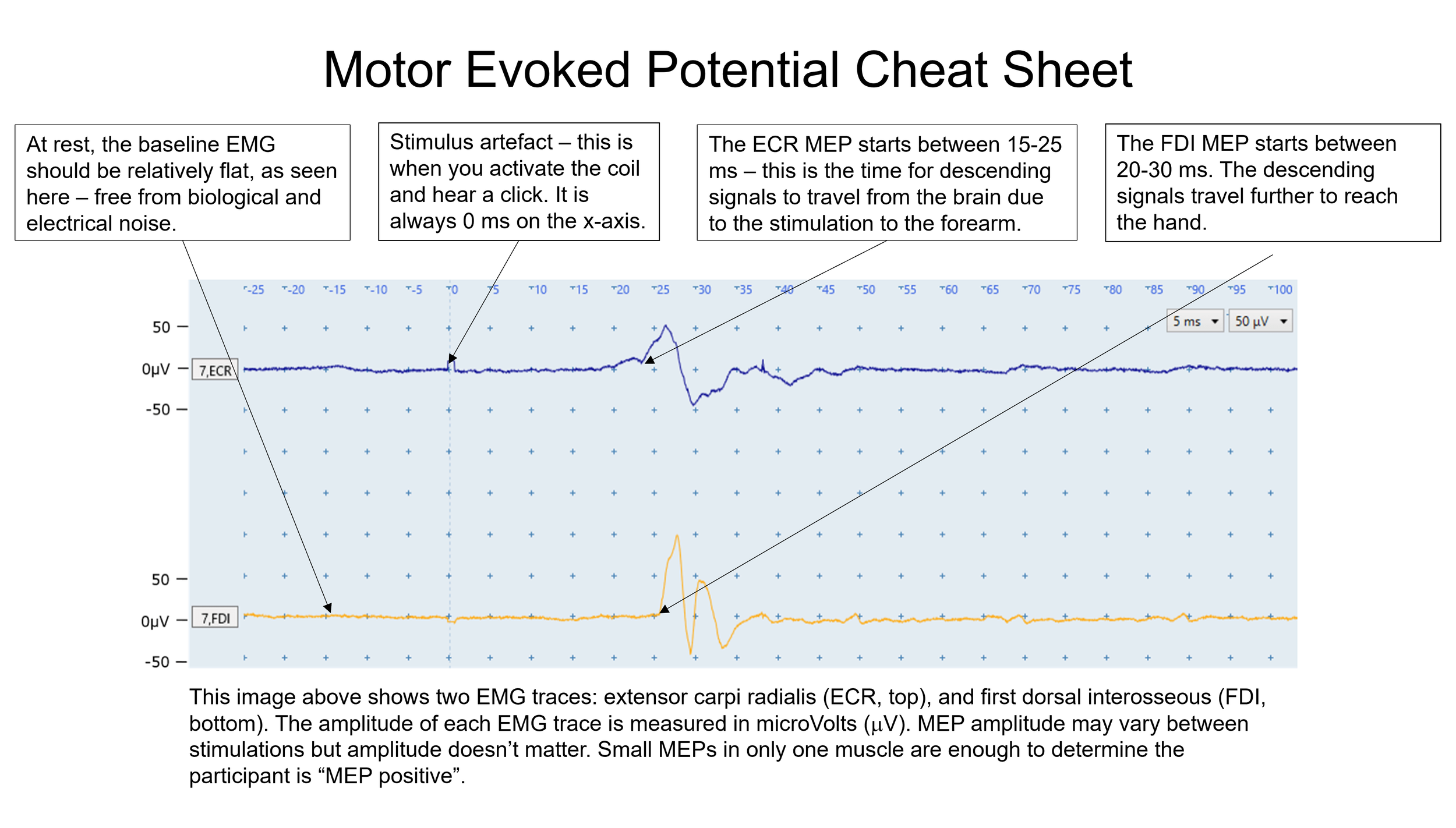
Classify a patient as MEP+ when a response of any amplitude occurs at an appropriate latency in either ECR or FDI, at rest or during bilateral facilitation.
Check the following before classifying a patient as MEP+.
MEP latency
MEP latency is the time interval between the stimulation and MEP onset in the target muscle. Typical MEP windows are 15 – 25 ms for ECR and 20 – 30 ms for FDI, allowing for the effects of stroke. Height also affects latency as shorter patients tend to have MEPs towards the start of these windows and taller patients towards the end.
If MEPs are seen at appropriate latencies in either ECR or FDI then classify as MEP+ and provide a Good prediction.
Responses occurring at inconsistent times across EMG traces are likely sporadic motor-unit firing rather than MEPs. Motor-unit responses have a consistent size and shape but usually fall outside the expected MEP latency window. If no true MEP is identified despite all efforts, classify the patient as MEP-.
If responses are seen at random times across the patient’s EMG traces then this is indicative of sporadic motor unit firing. Motor units firing can be identified due to their consistent size and shape in EMG traces. While the shape can sometimes resemble an MEP, they usually appear at latencies which do not correspond with the expected MEP latency. If you suspect motor unit responses rather than MEPs are present then a patient needs to be classified as MEP-, providing all efforts have been made to elicit a MEP if possible. Examples of EMG traces with motor units firing can be found in the EMG Technique module.
MEP consistency
Two MEPs within the appropriate latency window is sufficient for MEP detection. After detection, stimulate at the same position several times to assess consistency, until up to five MEPs have been obtained. Amplitude may vary between traces and does not affect MEP status.
Examples of simple MEP identification
These examples classify patients as MEP+ or MEP- based on MEPs in one or both muscles at an appropriate latency. Each trace is representative of all EMG traces at that stimulus intensity for the patient.
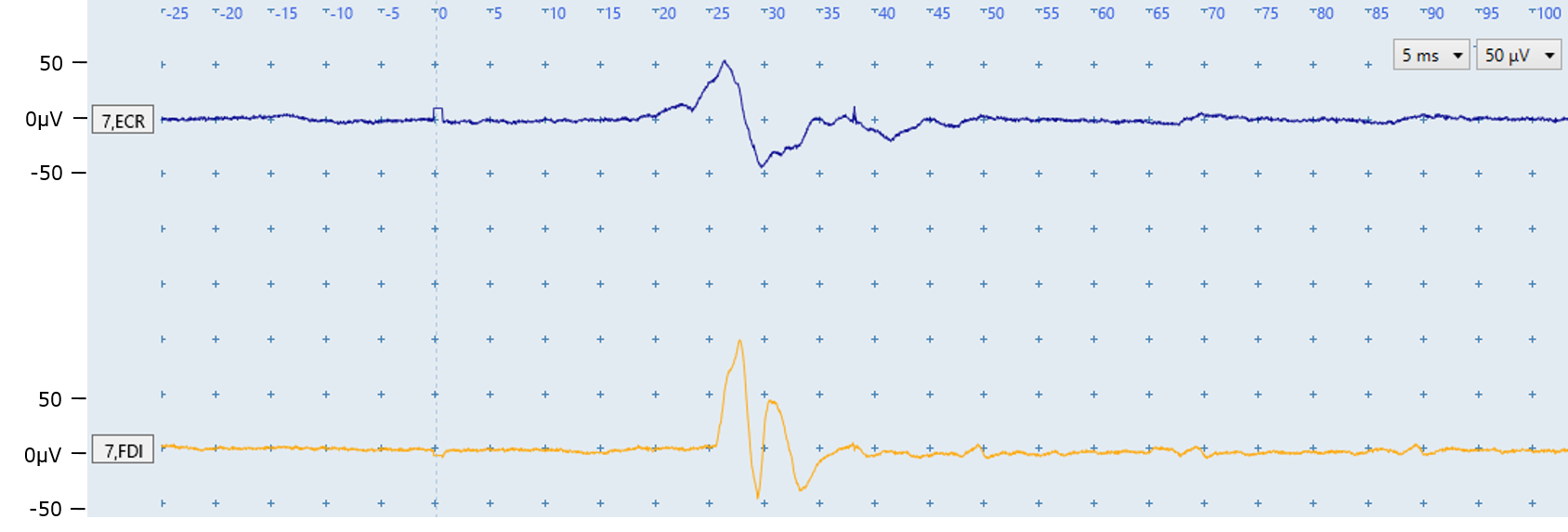
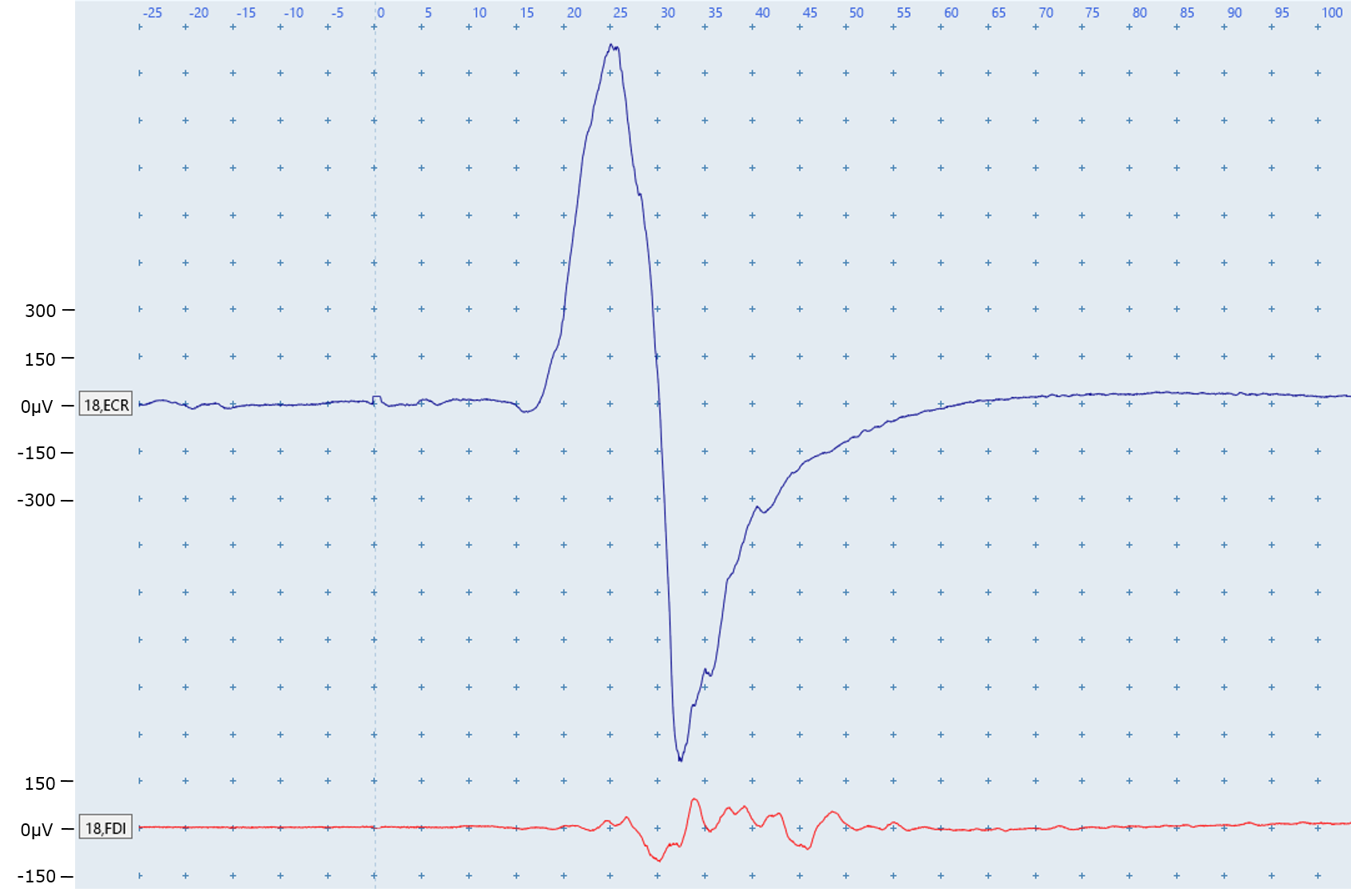
Patient A (height 5ft 8”, 173cm) at rest, 80% MSO
MEPs are present in both ECR (top trace) and FDI (bottom trace). As expected, FDI latency at 25 ms is slightly longer than ECR latency. Classify this patient as MEP+.
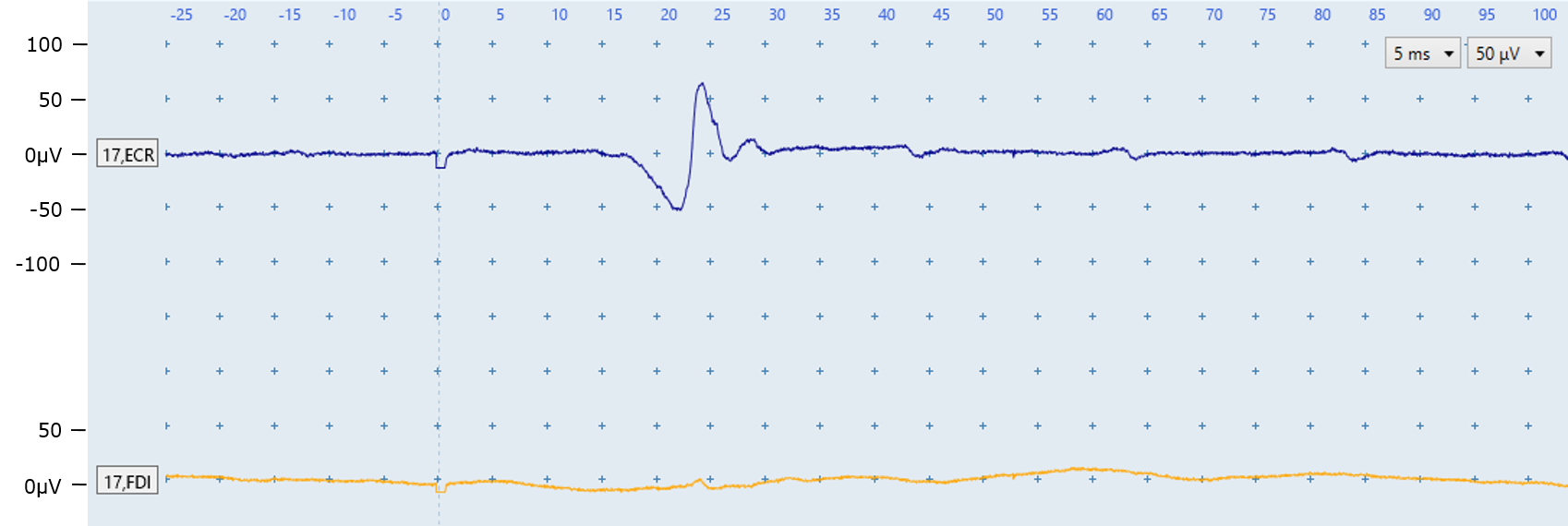
Patient B (height 5ft 4”, 163cm) at rest, 90% MSO
An ECR MEP occurs at an appropriate latency of approximately 18 ms. No FDI MEP is present. Classify this patient as MEP+ because an MEP in either muscle is sufficient.
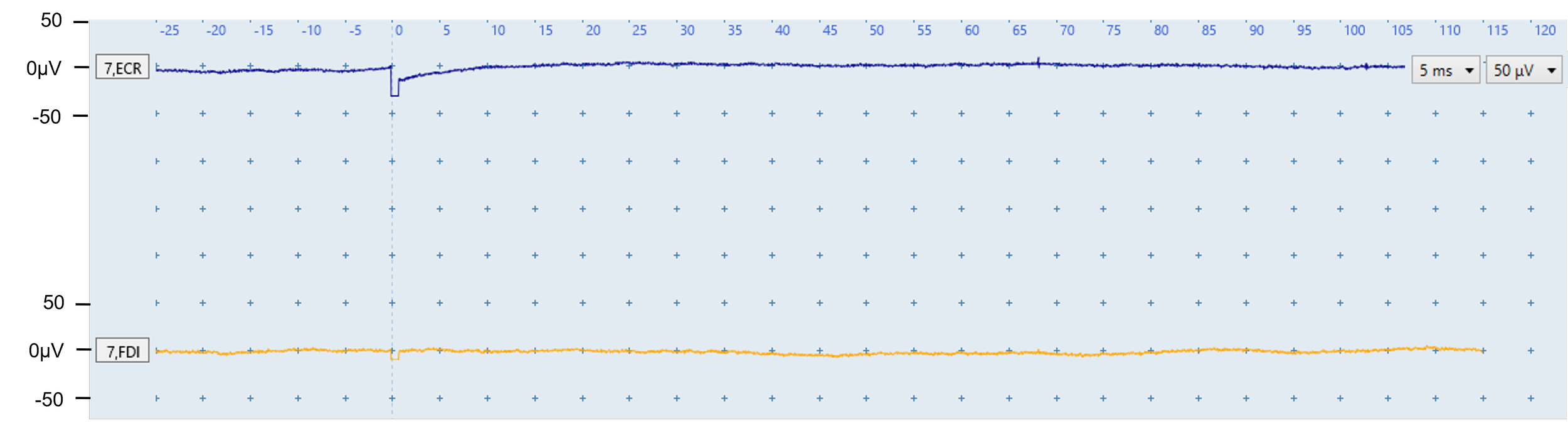
Patient C (6ft 0”, 183cm) performing bilateral facilitation,
100% MSO
No ECR or FDI MEP is present. The small deflections at 0ms are the stimulus artefacts. Classify this patient as MEP- because these traces were collected at 100% intensity during bilateral facilitation.
Patient D (5ft 6”, 168cm) at rest, 60% MSO
MEPs occur at appropriate latencies in both ECR and FDI. The FDI response is small, but amplitude does not determine MEP status. Classify this patient as MEP+. It is worth noting that they would be considered MEP+ based on FDI MEPs alone, if ECR MEPs were not present.
FAQs
I’ve finished the TMS test and I’m having trouble interpreting MEP status. I’m concerned about giving the patient an incorrect prediction. What should I do?
1
Take your time. Do not deliver a prediction until you are confident of the MEP classification. Tell the patient and family that you will return once the traces have been reviewed. Discuss uncertain traces with TMS-trained colleagues, consult the examples and quizzes on this page, or seek support from your TMS trainers.
What should I do if there is a MEP in only one muscle, but the latency is a little later than I expect?
2
Check whether the response recurs at a similar latency across traces. Variable latency suggests sporadic motor-unit firing which would be further supported if response size and shape are highly consistent.
Quiz
Complete the practice quiz.
Score at least 70% to receive the final quiz link by email.
Score at least 80% on the final quiz to receive a certificate of completion. Attempts are unlimited.